
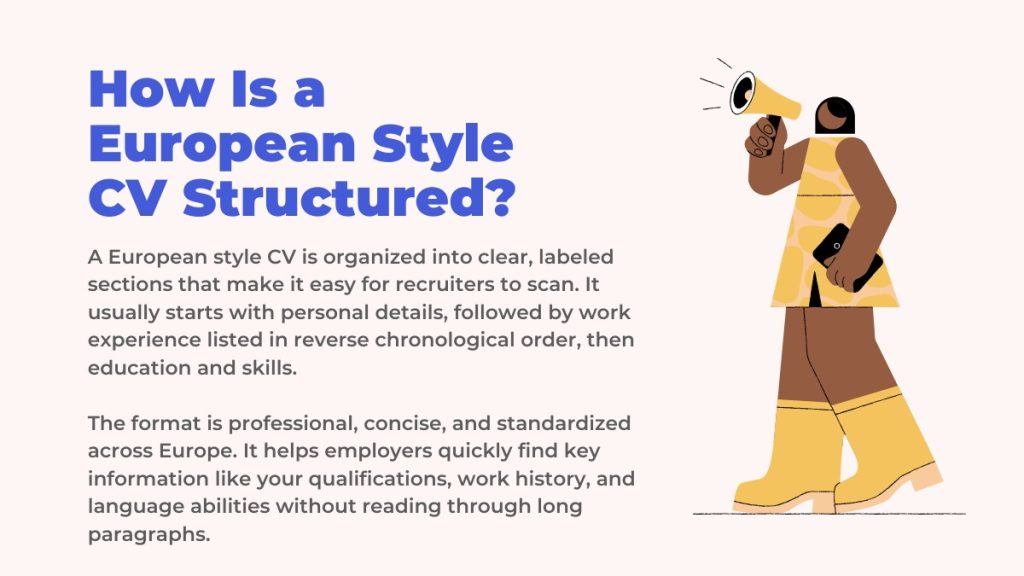
A mistake many applicants make is assuming that a resume that worked perfectly in their home country will automatically work in Germany, France, the Netherlands, Spain, or other European countries. In reality, recruiters often have different expectations when it comes to format, structure, and the type of information included.
That doesn’t mean European employers are harder to impress. They simply prefer a CV that presents information in a clear, organized, and professional way. Once you understand what recruiters are looking for, creating a strong European-style CV becomes much easier.
This guide will walk you through everything you need to know, from choosing the right format to presenting your experience effectively and avoiding common mistakes.
Understanding the European CV
Before writing your CV, it’s important to understand what employers expect.
In many European countries, the term “CV” is used instead of “resume.” While both documents serve the same purpose, a European CV is often more detailed and structured than the typical one-page resume commonly used in North America.
European recruiters usually want to see a clear timeline of your education and work experience. They appreciate consistency, accurate dates, and a logical layout that allows them to find important information quickly.
The goal isn’t to impress employers with fancy graphics or creative formatting. The goal is to make your qualifications easy to understand within seconds of opening the document.
Think of your CV as a professional summary of your career. It should tell employers who you are, what you’ve done, what skills you have, and why you might be a good fit for their organization.
Choosing the Right Length
One of the most common questions job seekers ask is how long a European CV should be.
The answer depends largely on your experience level.
If you’re a recent graduate with limited work experience, one page may be enough. However, for most professionals, a two-page CV is considered standard and perfectly acceptable.
Professionals with extensive experience, technical expertise, research publications, or senior-level positions may use three pages if necessary. The key is relevance. Every section should add value and help support your application.
Recruiters generally prefer a well-organized two-page CV over a one-page document that leaves out important information.
Start with Your Contact Information
The top section of your CV should contain your personal and contact details.
Include:
- Full name
- Phone number with international country code
- Professional email address
- City and country of residence
- LinkedIn profile
- Portfolio or personal website (if relevant)
Your email address should look professional. Ideally, it should contain your name rather than nicknames or random numbers.
For example:
looks much more professional than:
Recruiters often form their first impression within seconds, so small details matter.
Should You Include a Photo?
This is one of the biggest differences between European CVs and resumes used elsewhere.
In some European countries, especially Germany, Austria, France, Italy, and Spain, including a professional photo is still fairly common. In other countries such as the United Kingdom, Ireland, the Netherlands, and many Scandinavian countries, photos are becoming less common.
If you decide to include a photo, make sure it is professional.
Use a recent headshot with:
- Good lighting
- A neutral background
- Professional clothing
- A natural expression
Avoid vacation photos, selfies, heavily edited pictures, or casual social media images.
If you’re unsure whether a photo is appropriate, research local hiring practices in the country where you’re applying.
Write a Strong Professional Summary
The professional summary is one of the most important sections of your CV because it is often the first thing recruiters read.
This section should be short, usually three to four sentences.
Rather than using generic phrases, focus on your experience, expertise, and career goals.
For example:
“Digital marketing specialist with five years of experience managing paid advertising campaigns across European markets. Skilled in Google Ads, SEO, and performance analysis. Proven track record of increasing lead generation and reducing acquisition costs. Seeking opportunities within a growth-focused technology company.”
A summary like this immediately tells recruiters who you are and what value you bring.
Avoid overused statements such as:
- Hardworking team player
- Results-driven professional
- Dynamic individual seeking growth opportunities
These phrases are so common that they rarely make an impact.

Present Your Work Experience Clearly
The work experience section is usually the most important part of a European CV.
List your positions in reverse chronological order, starting with your most recent role.
For each position include:
- Job title
- Company name
- Location
- Employment dates
- Key responsibilities and achievements
For example:
Marketing Manager
ABC Technologies, Berlin, Germany
March 2022 – Present
- Managed digital campaigns across multiple European markets.
- Increased qualified leads by 35% within one year.
- Led a team of four marketing specialists.
- Reduced advertising costs through data-driven optimization strategies.
Whenever possible, include measurable achievements.
Numbers help employers understand the impact of your work.
Instead of writing:
“Managed company social media accounts.”
Write:
“Grew social media audience from 12,000 to 40,000 followers within 18 months.”
Specific achievements are far more convincing than general responsibilities.
Explain Employment Gaps Honestly
Many candidates worry about gaps in their employment history.
In reality, employment gaps are not necessarily a problem.
Recruiters understand that people take time away from work for many reasons, including:
- Further education
- Family responsibilities
- Travel
- Health recovery
- Career transitions
If you have a significant gap, briefly explain it.
A simple explanation is usually enough.
For example:
“Career break for postgraduate studies, September 2021 – June 2022.”
Transparency is generally appreciated more than leaving gaps unexplained.
Include Your Education
Your education section should also follow reverse chronological order.
Include:
- Degree title
- Institution name
- Location
- Graduation year
For example:
Bachelor of Science in Computer Science
University of Manchester, United Kingdom
Graduated: 2021
Recent graduates may also include:
- Thesis topics
- Academic projects
- Relevant coursework
- Honors and awards
Professionals with several years of experience can keep this section shorter since employers will focus more on work history.

Add Relevant Certifications
Professional certifications can strengthen your application significantly.
Examples include:
- Project Management Professional (PMP)
- AWS Certified Solutions Architect
- Google Analytics Certification
- ACCA
- Cisco Certifications
- Microsoft Certifications
Certifications demonstrate commitment to professional development and can help distinguish you from other candidates.
Create a Skills Section
European CVs typically include a dedicated skills section.
Divide your skills into categories if possible.
Technical Skills
Examples:
- Python
- SQL
- Java
- AutoCAD
- SAP
- Adobe Photoshop
- Microsoft Excel
Professional Skills
Examples:
- Project Management
- Data Analysis
- Strategic Planning
- Budget Management
- Stakeholder Communication
Avoid listing dozens of skills simply to fill space.
Focus on skills that are relevant to the position you’re applying for.
Highlight Language Skills
Language proficiency is particularly important in Europe because many workplaces operate across multiple countries and languages.
If you speak more than one language, include them clearly.
A commonly used standard is the CEFR framework:
- A1–A2: Basic
- B1–B2: Intermediate
- C1–C2: Advanced
- Native Speaker
Example:
- English – C2
- German – B2
- French – B1
- Urdu – Native
Always be honest about your language level. If you claim advanced proficiency, recruiters may test your skills during interviews.
Include Projects and Volunteer Work
Projects can be extremely valuable, especially for students, recent graduates, freelancers, and professionals changing careers.
Examples include:
- Software applications
- Research projects
- Marketing campaigns
- Design portfolios
- Freelance work
Volunteer experience can also strengthen your profile.
Many European employers appreciate community involvement because it demonstrates initiative, responsibility, and teamwork.
For example:
Volunteer Coordinator
Local Community Organization
2023–Present
- Organized fundraising events.
- Coordinated volunteers.
- Managed community outreach activities.
Mention Relevant Interests
Including hobbies and interests is optional, but it can add personality to your CV.
Choose interests that reflect positively on you.
Examples:
- Marathon running
- Photography
- Hiking
- Chess
- Open-source software contributions
- Learning foreign languages
Avoid controversial topics that could distract from your professional qualifications.
Keep this section brief.
Customize Your CV for Every Application
One of the biggest reasons applications get rejected is because candidates use the same CV for every position.
Recruiters can often tell when a CV has been sent to dozens of companies without modification.
Take time to adjust:
- Your professional summary
- Skills section
- Key achievements
- Keywords from the job description
If a company is looking for someone with experience in project management and stakeholder communication, make sure those strengths are clearly visible in your CV.
Tailoring your CV does not mean exaggerating your experience. It simply means presenting your most relevant qualifications first.
Common Mistakes to Avoid
Many otherwise strong candidates make simple mistakes that hurt their chances.
Some of the most common include:
Too Much Design
Complex templates with graphics, icons, and multiple columns may look attractive but can confuse applicant tracking systems.
Simple and clean layouts usually perform better.
Spelling and Grammar Errors
Even minor mistakes can create a negative impression.
Always proofread your CV carefully before submitting it.
Missing Dates
Employers expect clear timelines.
Always include months and years for education and employment history.
Too Much Information
Your CV should be detailed but focused.
Avoid including every job you’ve ever had if it is not relevant.
Generic Language
Replace vague statements with specific examples and achievements.
Specificity builds credibility.
Should You Use Europass?
The Europass CV is an official European CV format recognized throughout the European Union.
Its advantages include:
- Easy to create
- Standardized structure
- Widely recognized
- Suitable for public sector positions
Its disadvantages include:
- Generic appearance
- Limited customization
- Less personal branding
For internships, public institutions, and some international organizations, Europass can be a good choice.
For private companies, a professionally designed custom CV often creates a stronger impression.
Final Checklist Before Sending Your CV
Before submitting your application, review the following checklist:
- Is your contact information correct?
- Is the document easy to read?
- Are dates accurate and consistent?
- Have you included measurable achievements?
- Have you checked grammar and spelling?
- Is the file saved as a PDF?
- Have you tailored the CV to the job description?
- Is the layout professional and uncluttered?
Taking a few extra minutes to review your CV can prevent mistakes that might otherwise cost you an interview opportunity.
Final Thoughts
Writing a European-style CV isn’t about following complicated rules. It’s about presenting your experience in a way that employers can quickly understand and appreciate.
A strong CV should be clear, organized, honest, and relevant. Focus on your achievements, provide accurate information, and tailor your application to each position.
Remember that your CV is often your first introduction to an employer. Before you ever attend an interview, your CV is already speaking on your behalf.
Make sure it tells the right story.


